
Backing & Laying
Previously, on the bookie, you could place a bet if you thought the team would win. However, you could not place a bet if you thought the team would lose. Of course, you could indirectly accomplish this by betting on the other team to win, but in varying scenarios this may not always be possible. This type of bet where you believe the team will win is called a back bet, and we say that you are backing the team.
On an exchange, you can back bets, but you also have the ability to bet on a team to lose. This is known as a lay bet, in which case we say that you are laying the team.
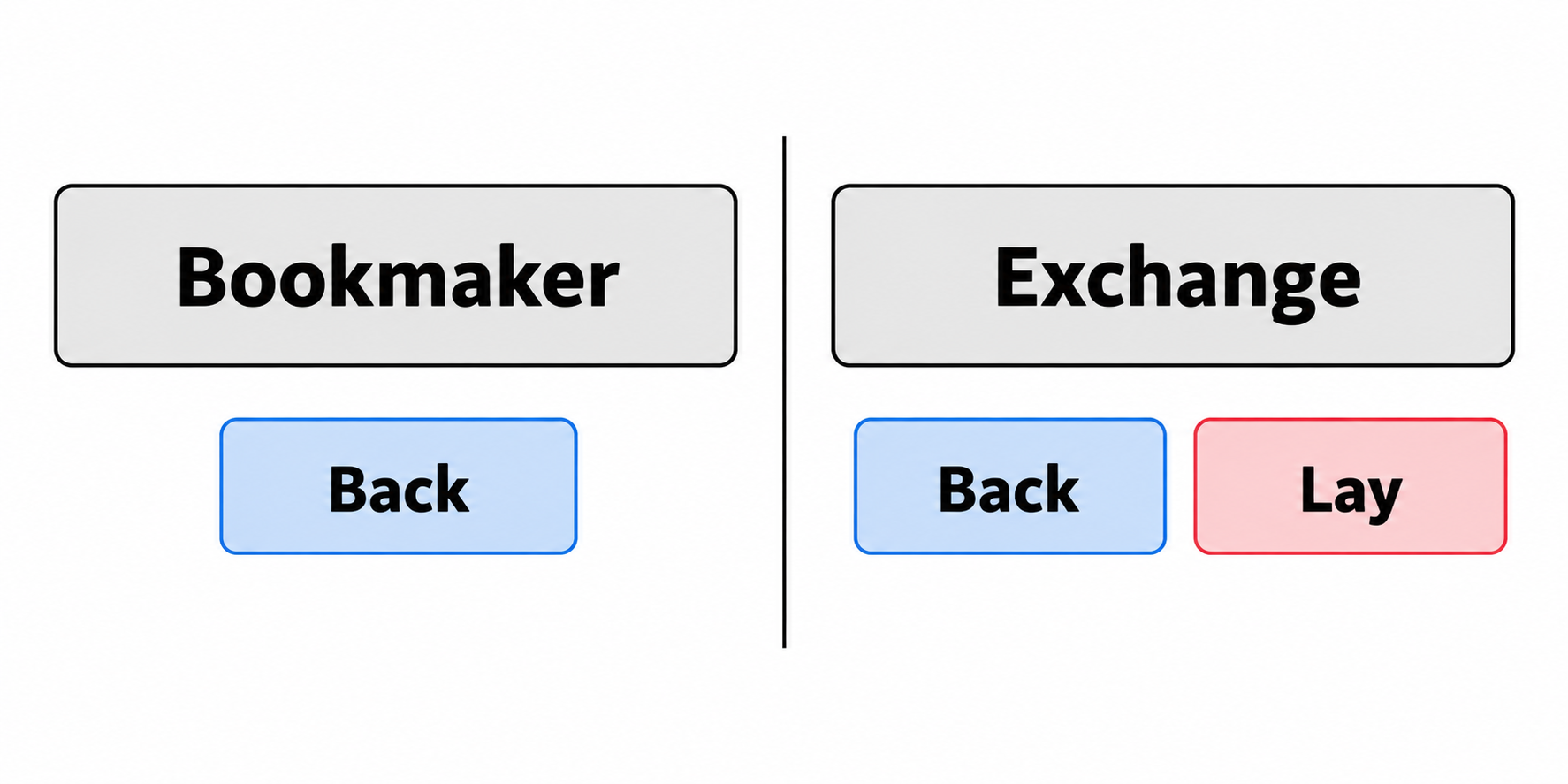
These terms are generalised below.
Back: Wagering that the outcome will occur.
Lay: Wagering that the outcome will not occur.
On an exchange, you can back or lay an event. However, in both cases the stakes must be matched by an opposing side (another person).
The terms and calculations used in this example will be formulized later; this is merely an introduction.
Example 2.1. Consider two people, James and Amy, who both want to bet on a particular team of a football match. James thinks the team will win, so he wants to place a back bet. On the other hand, Amy thinks the team will lose, so she wants to place a lay bet.
James decides that he will back at odds , and asks Amy to match that.
If Amy agrees, then she will have to cover James' potential profit if the team wins, which would be (from lesson 1.2). However, if the team loses, then Amy will receive James' wagered amount, so she would profit .
Amy declines, and thinks it would be fairer if the odds were . She asks James' if he will match that.
If the team wins, Amy will have to cover his profit, which is now . If the team loses, Amy still profits the from James' stake.
James agrees, and the bet is matched.
In this example, James placed a back bet, and Amy placed a lay bet. Notice how, even though both parties proposed bets, a final decision was not made until they agreed on the same odds. In other words, James could not back without Amy laying at the same odds, and visa versa. In actuality, both parties must also agree on the stake as well as the odds.
If you want to back or lay at certain odds and stake, you submit those odds into the market to await approval from the opposing side (often referred to as the counterparty). This is known as placing the bet. If the opposing side agrees to your odds and stake then we say that the bet is matched. A bet which has been placed but not matched is referred to as unmatched.
Keep in mind, this terminology is interchangeable when talking about bookmakers, but is not the same thing when talking about exchanges.
Also note it, even though it was introduced this way, it can be confusing to refer to a lay bet as 'betting on the team to lose'. In the context of sports betting, a bet wins if it succeeds, and a bet loses if it fails - regardless of the type of bet (back or lay). In the context of Placeback, a win, loss, and place will be properly defined later on.