
Fundamentals: Bonus Back Bets
The strategy that we will use involves betting in a way that mathematically favours the acquisition of bonus bets while minimizing losses. Essentially, we profit by receiving bonus bets without losing any money.
There are several types of bonus bets, each of which are given under different conditions. The type of bonus bet we will be using is known as a bonus back bet.
Bonus back bet: Applicable to horse races. If a staked horse finishes within a certain spread of positions (in which case we say the horse placed), the stake will be returned to the user as a bonus bet.
Example 5.1. Suppose you back a horse to win on a bookmaker. The bookmaker is offering a bonus back promotional deal on this race, meaning if any horse doesn't win but instead comes second or third, you get your money back as a bonus bet. You wager and place the bet.
Unfortunately, the horse doesn't win but instead comes third, meaning the bonus bet is applicable. Even though you lose the stake, you now have a monetary voucher worth (because you got the stake back as a bonus bet).
Of course, by itself, this is not profitable. However, much like converting bonus bets, the exchange can be used to mitigate losses in the event of the horse losing. In fact, the exchange can be used to guarantee a profit if the horse wins or places (as shown in Example 5.2), meaning all we need to do is figure out which horses are mathematically likely to come in the top three (which is much easier than trying to determine which horse will win). This can be done with Placeback, and will be explained later on.
Before we get into the example, some terminology must be defined.
We say a horse wins if it comes first.
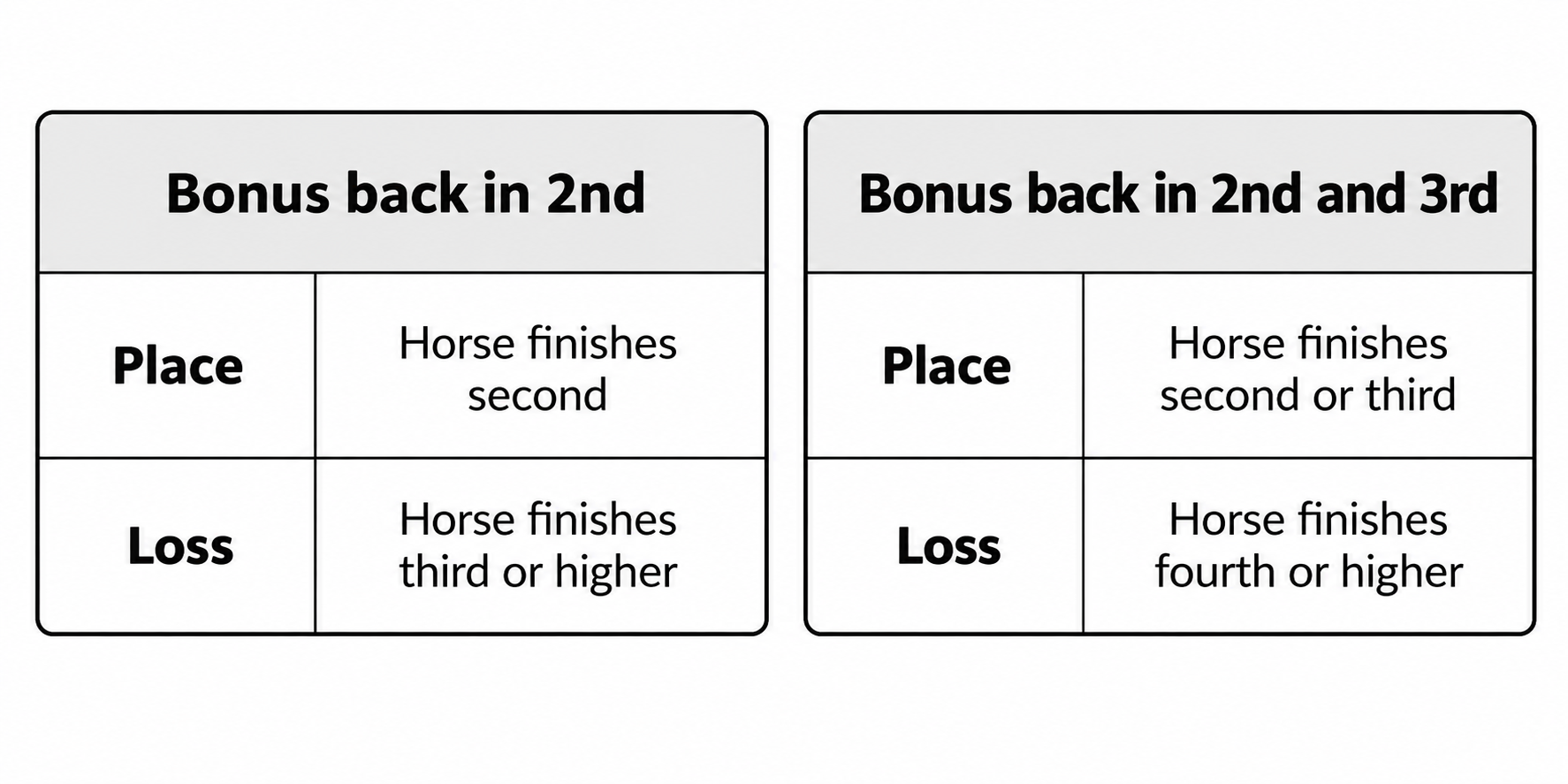
We say a horse places if it comes second or third (*this is dependent on the scenario)
We say a horse loses if it does not win or place
*The definition of a horse placing is dependent on the type of bonus back bet. Most bonus back bets are applicable if the horse places second or third, while some are only applicable if the horse places second. In the latter scenario, a place would be the horse coming second, and a loss would be the horse finishing in third or above. However, in the first case, a place would include the horse finishing in second or third, and a loss would be the horse finishing in fourth or above.
We call the value of an unconverted bonus bet unrealised profit. When this bet is converted, it is realised. Note that the unrealised and realised profits may not be equal (and usually they are not).
The following example is a real scenario taken from Placeback.
Example 5.2. Suppose you find the following odds for a runner.
Bookmaker back odds:
Exchange lay odds:
Exchange commission:
The bookmaker is also offering the following promotion on the runner's race
Runner places 2nd or 3rd, get your money back as a bonus bet
You place two bets:
Back at odds on the bookmaker
Lay at odds on the exchange
Outcome 1: The runner wins
The bookmaker bet wins, and the lay bet loses. No bonus is awarded.
Bookmaker profit:
Exchange profit: Total realised profit is
Outcome 2: The runner places
The bookmaker bet loses, and the lay bet wins. A bonus of is awarded.
Bookmaker profit: , but remember a bonus bet is awarded of credit value .
Exchange profit: Total unrealised profit is
However, we have of unrealised bonus bets. Assuming a standard conversion rate of , this will be converted into , bringing the total realised profit to
.
Outcome 3: The runner loses
The bookmaker bet loses, and the lay bet wins. No bonus is awarded.
Bookmaker profit:
Exchange profit:
Total realised profit is
Summary
Runner wins:
Runner places: (potential for more depending on the conversion rate)
Runner loses:
Remember, we have a system which accurately predicts which runners will come place. The usage of this system will be explained later.